


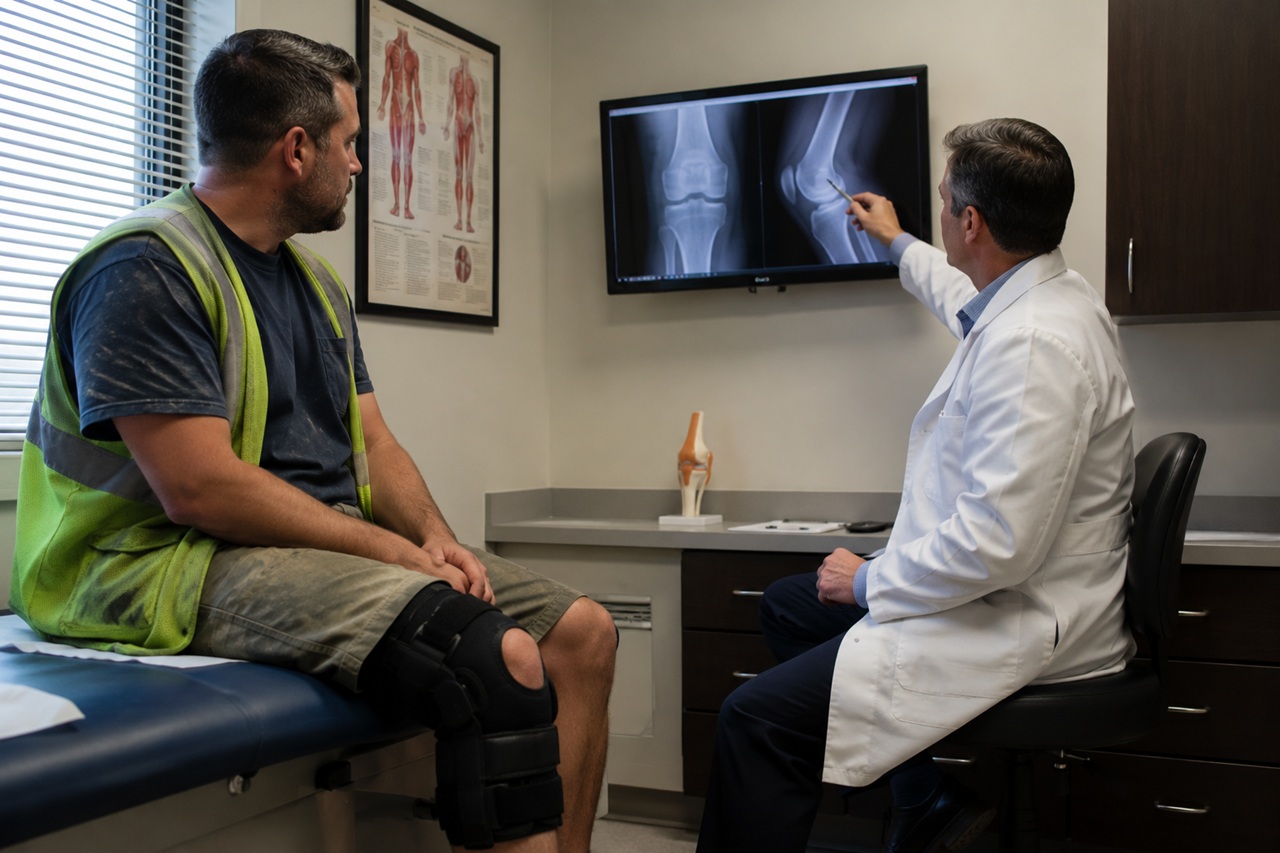
A Work-Related Knee Replacement Claim Can Become A Fight Over Medical Proof
A knee injury at work can sideline a person for weeks, and when the damage is severe enough to require a total or partial knee replacement, the stakes get considerably higher. Knee replacement surgery is one of the most significant and costly procedures a worker can face, and the recovery period, often months of physical therapy and limited mobility, can leave a worker unable to earn a paycheck for an extended period.
For New Yorkers hurt on the job, the question is not just whether surgery is necessary. It is whether the system will cover it.
New York’s workers’ compensation system is designed to cover medical treatment, including surgery, when an injury is work-related. But getting a major procedure like a knee replacement approved is rarely as straightforward as filling out a form. Insurance carriers push back. Pre-existing conditions are used against workers. Medical opinions conflict.
Our attorneys at Pasternack Tilker Ziegler Walsh Stanton & Romano, LLP have been navigating these disputes for injured New York workers for over 90 years, and we know exactly how insurance companies try to avoid paying for the care workers have earned.
Knee replacement surgery, also known as total or partial knee arthroplasty, involves removing damaged cartilage and bone from the knee joint and replacing them with an artificial implant. It is most commonly recommended when the knee has been so severely damaged that other treatments, including physical therapy, steroid injections, and arthroscopic procedures, have failed to provide adequate relief. For workers in physically demanding jobs, that level of damage can result from a single traumatic injury or years of repetitive stress on the joint.
What Types Of Work-Related Knee Injuries Can Lead To Knee Replacement?
Not every workplace knee injury leads to replacement surgery, but certain types of job-related trauma create conditions where replacement eventually becomes the best option. Workers in construction, manufacturing, healthcare, transportation, and other physically demanding industries carry the greatest risk, though knee injuries happen across nearly every line of work.
The work-related knee injuries most likely to result in replacement surgery include the following categories, each of which can qualify for workers’ compensation coverage in New York:
- Traumatic Knee Injuries From Falls Or Impacts: A fall from a ladder, scaffold, or elevated surface, or a direct impact to the knee from machinery, a vehicle, or a heavy object, can fracture the patella, tear multiple ligaments at once, or shatter the cartilage protecting the joint. When the structural damage is extensive enough, replacement surgery may be recommended even for relatively young workers.
- Torn Meniscus With Advancing Joint Damage: The meniscus is the cartilage cushion that absorbs shock between the femur and tibia. A work-related tear, particularly one that goes untreated or is repeatedly aggravated by continued job duties, can accelerate the breakdown of surrounding cartilage and lead to severe knee osteoarthritis.
- Repetitive Stress And Occupational Osteoarthritis: Workers who spend years kneeling, squatting, climbing stairs, or lifting heavy loads place chronic stress on the knee joint. New York workers’ compensation law covers occupational diseases, meaning a worker whose job duties caused or substantially contributed to severe knee osteoarthritis may be entitled to coverage for replacement surgery, even without a single identifiable accident.
- Aggravation Of A Pre-Existing Knee Condition: Many workers have prior knee injuries or underlying degeneration before a workplace incident occurs. Under New York law, workers’ comp can still cover treatment, including surgery, if job duties or a work-related accident significantly aggravated or accelerated that pre-existing injury or condition. The insurance company will argue the damage was already there. That argument needs to be countered with strong medical evidence.
- Crush Injuries And Workplace Accidents: Workers struck by vehicles, caught between pieces of machinery, or buried under collapsed material can suffer crush injuries to the knee that destroy bone and soft tissue beyond repair. These cases often require emergency intervention followed by reconstructive or replacement surgery.
In all of these situations, the key to coverage is establishing a clear medical and factual connection between the worker’s job duties or workplace incident and the knee condition requiring surgery. That connection is where insurance carriers typically concentrate their challenges.
How Does Workers’ Compensation Cover Knee Replacement Surgery In New York?
New York’s workers’ compensation system covers the cost of reasonable and necessary medical treatment for work-related injuries, including surgery, hospitalization, anesthesia, post-operative care, physical therapy, and durable medical equipment needed during recovery. There is no dollar cap on medical benefits in New York workers’ comp. If the surgery is approved and the treating physician recommends it, the costs should be covered.
The approval process, however, involves several steps, and each one gives an insurance carrier an opportunity to slow things down or deny the claim outright. That is especially true when a worker needs an expensive procedure, has a prior knee condition, or has already been out of work for a significant amount of time.
For workers facing a major procedure, injuries requiring surgery often raise the stakes of a workers’ compensation claim because the medical costs, recovery time, and wage loss can be significant. Insurance companies know that, which is why surgical claims often get more scrutiny.
What Steps Are Often Involved In The Workers’ Compensation Approval Process?
The treating physician must first document that knee replacement surgery is medically necessary and causally related to the work injury. That documentation needs to be detailed and specific. Vague notes linking symptoms to general wear and tear, without tying them to job duties, give the insurance company room to argue that the condition is not compensable.
Once the treating physician submits a request for prior authorization, the insurance carrier reviews it and may approve it, deny it, or request an independent medical examination. These examinations are performed by physicians chosen and paid by the insurance company, and their opinions frequently conflict with those of the worker’s own treating doctor.
A conflicting independent medical examination opinion does not end the claim, but it can create a formal dispute that often has to be resolved through a hearing before the New York Workers’ Compensation Board.
Workers also have the right to choose an authorized treating doctor in New York. That can make a major difference in a knee replacement claim because a worker needs a physician who understands the job duties involved, documents the injury carefully, and explains how the surgery relates to the workplace accident or occupational exposure.
What Happens If Your Workers’ Comp Claim For Knee Surgery Is Denied?
A denial is not the end of the road. In New York, injured workers have the right to contest a denial and present their case to a Workers’ Compensation Law Judge. The hearing process allows the worker’s attorney to introduce medical evidence, cross-examine the insurance company’s medical examiner, and argue that the requested surgery is both medically necessary and causally connected to the work injury.
Many denials are overturned through this process when the worker has proper legal representation and the right medical proof.
The most common reasons insurance carriers deny workers’ comp claims for knee replacement surgery include:
- Disputed Causal Relationship: The insurer argues the knee damage is unrelated to the work injury or predates employment. The response is detailed medical evidence, often from an orthopedic specialist, documenting how the work injury caused, aggravated, or accelerated the condition requiring surgery.
- Claim That Surgery Is Not Medically Necessary: The insurer’s medical examiner may claim that the worker has not yet exhausted conservative treatments. The response is documentation from the treating physician explaining why conservative measures are no longer adequate and why surgery is the appropriate next step.
- Pre-Existing Condition Defense: The insurer argues that the worker’s knee was already degenerating before the workplace incident. Under New York law, workers’ comp can still cover injuries that aggravate or accelerate a pre-existing condition, and medical evidence must show the job’s role in that aggravation.
- Delayed Filing Or Procedural Issues: The insurer questions whether the claim was filed within the required deadlines or whether the injury was properly reported. An attorney can address these procedural challenges and, in many cases, preserve the worker’s right to benefits even when forms were not filed perfectly.
- Credibility Challenges: In some cases, insurers argue that the worker’s account of how the injury occurred is inconsistent or unsupported. Witness statements, accident reports, surveillance records, and a well-developed factual record can effectively rebut these challenges.
When an insurance carrier refuses to approve surgery, a denied workers’ compensation claim can still be challenged through the New York workers’ compensation system. An attorney can demand a hearing, present medical evidence, question the carrier’s medical examiner, and fight to prove the surgery is work-related and medically necessary.
Can Repetitive Job Duties Lead To A Covered Knee Replacement?
Yes. A knee replacement claim does not always begin with one dramatic workplace accident. Some workers develop serious knee damage after years of kneeling, lifting, climbing, squatting, carrying, or walking on hard surfaces. These claims can be harder to prove because the insurance company may argue that the knee condition is simply the result of aging or ordinary degeneration.
New York workers’ compensation can cover occupational injuries that develop gradually over time when job duties caused or substantially contributed to the condition. Workers with severe knee osteoarthritis, meniscus damage, or chronic joint deterioration may still have a valid claim if the medical evidence connects the condition to their work.
That is why repetitive-duty knee claims often require careful documentation of job tasks, work history, medical records, and orthopedic findings. Workers who develop repetitive stress injuries over time may still qualify for workers’ compensation benefits when the medical evidence connects the condition to their job duties.
What Benefits Are Available While Recovering From Knee Replacement Surgery?
Beyond surgical coverage, workers approved for knee replacement may also be eligible for wage-replacement benefits during recovery. New York workers’ comp generally pays approximately two-thirds of the worker’s average weekly wage, up to the state’s maximum limit, while the worker is temporarily disabled.
Recovery from knee replacement can take months, and many workers cannot safely return to jobs that require standing, climbing, kneeling, carrying, or operating equipment until they have completed rehabilitation. If the worker can return only in a limited capacity, partial wage benefits may also be available.
If the surgery results in a permanent impairment of the knee, which is common even after a successful replacement, the worker may also be eligible for a permanency award. This type of award compensates the worker for the lasting loss of use of the leg and is separate from medical treatment and temporary wage benefits.
After a serious workplace injury, workers’ compensation benefits may include medical care, wage replacement, permanency awards, and other support while an injured worker recovers or adjusts to lasting limitations.
How Can A New York City Workers’ Compensation Lawyer Help You?
Knee replacement surgery is a major medical procedure with a long recovery, significant costs, and real consequences for a worker’s livelihood. When an insurance company stands between a worker and the surgery their doctor says they need, having an attorney who knows how to fight that battle can make a concrete difference in what the worker receives.
At Pasternack Tilker Ziegler Walsh Stanton & Romano, LLP, our attorneys handle workers’ compensation cases for injured New Yorkers across every industry and every borough. We know how insurance carriers build their defenses against surgical claims, how to develop the medical evidence needed to counter them, and how to present a worker’s case before the Workers’ Compensation Board when a carrier refuses to approve treatment.
We have been doing this for over 90 years, and we prepare every case as though it is going to trial, which is why insurance companies often offer our clients strong settlements before it gets that far.
Our attorneys represent injured workers on a contingency fee basis. You pay nothing unless we recover for you, and in New York workers’ comp cases, the fee is set by a Workers’ Compensation Law Judge. If you or someone in your family suffered a serious knee injury at work and you are facing a dispute over surgery coverage or benefits, contact us for a free consultation. We have 12 offices across New York, including five in New York City.
Prior results do not guarantee outcomes.
Attorney Advertising.